Tom Barker, Institute of Development Studies, UK
This brief synthesises insights from interviews and group discussions conducted across the GHRU, as well as drawing on information documented by the Unit. It brings together perspectives from senior scientific leaders, programme managers, and early- and mid-career researchers working in Ethiopia, Rwanda, and Sudan, and based in the UK.
The purpose of this brief is to:
- Draw together shared experiences, challenges, and achievements in capacity strengthening.
- Identify recurring patterns and tensions across roles, countries, and career stages.
- Capture practical learning about what supports and limits sustainable capacity building.
- Articulate lessons to inform future global health research programmes and funders.
1. Starting Conditions
Capacity building began from highly uneven starting points across countries and institutions. In some settings, existing partnerships and research infrastructure provided a foundation for growth, while elsewhere research environments were characterised by limited infrastructure, weak administrative systems, and low levels of prior exposure to international collaboration.
These differences reflected deeper structural constraints, including limited domestic research funding, heavy teaching and institutional responsibilities, and persistent brain drain. Importantly, capacity trajectories were shaped not only by institutional context, but also by recruitment decisions and the alignment between individual motivations and project goals.
At doctoral level, additional barriers shaped the experience of capacity building. These included delays in ethics approval, bureaucratic processes, limited laboratory and data access, visa and travel restrictions, and challenges associated with working with highly mobile or vulnerable populations. These operational realities underline the importance of designing capacity strengthening approaches that are responsive to both structural and practical constraints.
2. Capacity building as both rationale and achievement
Across all perspectives, capacity strengthening is seen as both the primary purpose of the GHRU and its most significant achievement. Participants described substantial progress in building research skills, strengthening laboratories, and enabling individuals to contribute more actively to research and policy processes.
PhD students provided a particularly detailed account of these changes, highlighting the development of advanced technical and analytical skills across a wide range of domains, including modelling, bioinformatics, qualitative research, and economic analysis. Beyond technical proficiency, students emphasised growing independence and the ability to interpret research findings in relation to implementation, equity, and policy relevance.
Crucially, capacity building extended far beyond technical skills. Participants consistently highlighted gains in leadership, teamwork, communication, confidence, emotional resilience, and ethical practice. These attributes were seen as essential for navigating complex research environments and sustaining long-term engagement in national research systems.
3. Institutional and professional services capacity: the enabling layer
A defining feature of the GHRU approach was its explicit investment in institutional and professional services capacity. Weaknesses in finance, procurement, and grant management systems were identified as major constraints on research delivery, even where scientific expertise existed.
In response, the Unit invested in strengthening these systems through dedicated capacity budgets, mentoring, training, and regular support mechanisms. While this level of involvement raised questions about partnership dynamics, it was widely understood as necessary for building sustainable institutional capacity.
Experiences at PhD level reinforced the importance of this enabling layer. Delays related to administration, infrastructure, and logistics directly affected students’ ability to progress. These insights highlight that individual capacity cannot be developed in isolation from the systems that support it.
4. Career pathways and the ‘missing middle’
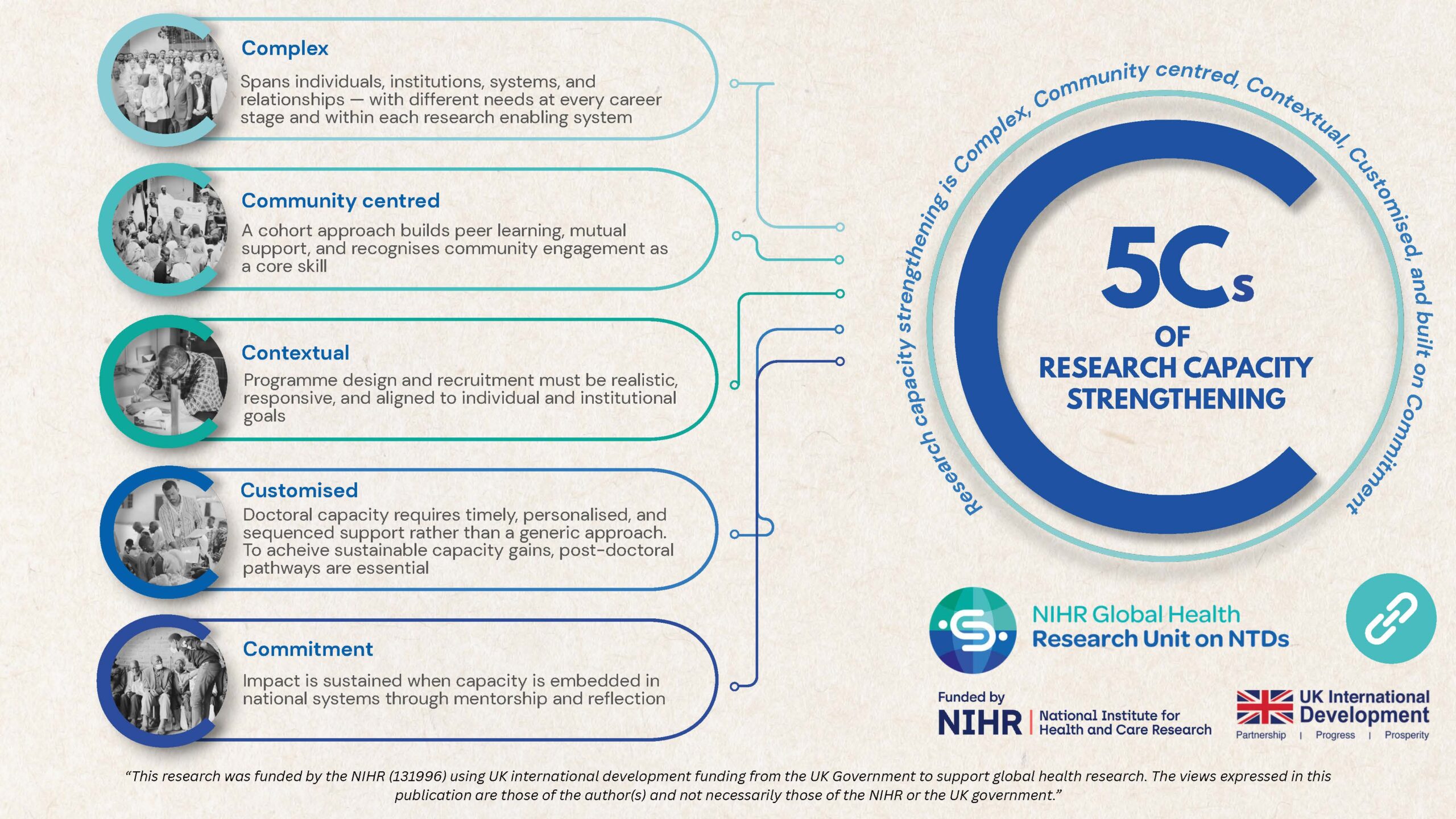
Career pathways emerged as a critical gap within capacity strengthening efforts. PhD training was widely viewed as transformative, providing opportunities that were otherwise scarce. Cohort-based approaches and peer support helped reduce isolation and foster collaboration.
However, important limitations were identified in how doctoral support was structured. Students reported that training was often delivered too late, after they had already developed skills independently. There was strong demand for earlier, more tailored training aligned to different stages of the PhD, particularly in academic writing, proposal development, and time management.
Students also emphasised the need for clearer links between doctoral training and future career opportunities, including exposure to networks, employers, and post-PhD pathways. At the same time, concerns were raised about unrealistic workloads within the time constraints of doctoral programmes.
Beyond the PhD, a significant gap exists at postdoctoral and mid-career levels. Limited opportunities for progression, grant development, and leadership roles create a risk of attrition. Where structured postdoctoral pathways do exist, they have proven highly effective in supporting career progression and leadership development. Two rounds of NIHR Global Health Research Unit funding enabled several phase one PhD students to progress into post-doctoral researcher positions in phase two. The strengthening of these pathways was highlighted as something that lead partners and funders should work together to provide greater support for, including through the facilitation of career mentoring and opportunities to interact with potential employers.
5. Mentorship, management, and reflective practice
Capacity strengthening was consistently described as a relational and iterative process. Informal mentoring, regular meetings, and opportunities for reflection were often more impactful than formal training programmes.
Students highlighted the importance of supportive supervision, noting that regular engagement with supervisors helped maintain motivation, confidence, and progress. At the same time, they called for more structured mentorship models from the start of the programme, including access to mentors beyond immediate supervisors and guidance on career development.
The findings suggest that effective capacity strengthening requires a broader mentoring architecture that integrates technical guidance, personal support, and career development. Supervisory relationships themselves were also identified as sites of learning, with senior staff developing new skills in leadership and communication.
6. Field-level, community, and health system capacity
Capacity strengthening extended beyond formal research roles to include field teams, health workers, and communities. In many settings, capacity was built through intensive, on-the-job learning, supported by close supervision and daily feedback.
Community engagement emerged as a central component of this work. Researchers developed skills in building trust, navigating cultural contexts, and working with diverse and marginalised populations, including street-connected children in Ethiopia, remote communities, and traditional healers.
These experiences highlight that community engagement is not simply an outcome of research, but a specialised skill set requiring negotiation, ethical sensitivity, and contextual understanding. Qualitative approaches were particularly important for capturing lived experience and informing more responsive research design.
7. Crisis as disruptor and catalyst
Crises such as COVID-19, the conflict in Sudan, and insecurity in parts of Ethiopia significantly shaped capacity building trajectories. These events disrupted research activities but also created opportunities for innovation, localisation, and adaptation.
Participants emphasised that the ability to respond to crisis depended on strong relationships, flexible funding, and trust between partners. At the same time, the doctoral experience highlighted the personal impact of uncertainty and disruption, including stress, delays, and the need to adapt research plans.
Students stressed the importance of recognising that research rarely proceeds as planned and of building supportive environments that allow for adaptation, flexibility, and openness about challenges.
8. Policy engagement and system-level influence
Increased engagement with policy processes was seen as a downstream effect of strengthened research capacity. As researchers gained confidence, credibility, and networks, they were better positioned to influence policy and practice, scabies treatment protocols in Sudan and national advisory roles and guideline development in Ethiopia.
At doctoral level, students described developing the ability to think beyond data generation, considering how findings relate to implementation, equity, and policy relevance. This highlights the value of developing capacities for policy engagement early in research careers, contributing to longer-term system influence.
9. Sustainability and unresolved tensions
Sustainability remains a central concern across all perspectives. Many aspects of capacity strengthening – including infrastructure, staffing, and training – have depended heavily on external research and aid funding. Without continued investment, there is a risk that progress may not be sustained. Research funding must be considered a critical component of discussions about alternative post-aid funding arrangements, including domestic resource mobilisation and prioritisation.
PhD students highlighted sustainability challenges such as the need for more practical and context-specific training, improved emotional support, realistic workloads, and stronger alignment between training and career ambitions.
They also highlighted the importance of addressing the emotional dimensions of research, including fear of failure, uncertainty, and the impact of setbacks. These factors can influence both performance and long-term retention within research systems.
Several key lessons emerge from this learning exercise
Overall, the GHRU has demonstrated that capacity strengthening can deliver significant and lasting change when it combines technical training with relational, institutional, and systemic investment. Future programmes can build on this experience by placing greater emphasis on early-stage training design, structured mentorship, career pathways, and the broader conditions that enable researchers and professional team members to thrive.