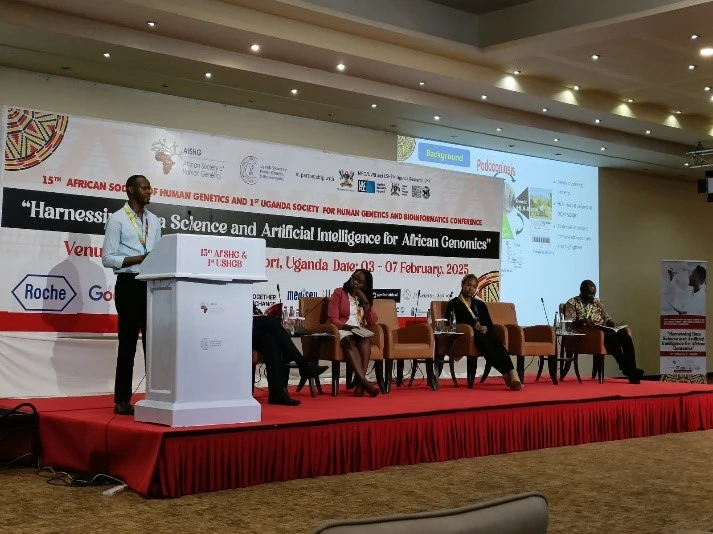
Jean Pierre Ngangali, Prof Melanie Newport and Prof Leon Mutesa represented the GHRU Phase 2 at the 15th African Society of Human Genetics Meeting, held in Entebbe jointly with the 1st meeting of the Ugandan Society of Human Genetics and Bioinformatics in Entebbe 3-7th February 2025.


NIHR PhD student Jean Pierre Ngangali had the opportunity to learn about multi-omics approaches to understanding diseases after being selected to participate in the ‘Practical Approaches to Research and Discovery Using African Genomic Diversity’, apractical course organized by Wellcome Connecting Science. He presented two posters: one on his rapid ethics appraisal (REA) study which was undertaken in preparation for doing genetics studies on podoconiosis in Rwanda, the subject of his second poster presentation. Jean Pierre was part of the prize-winning team undertaking a practical exercise during the training course, which aimed to ask relevant research questions and then design methodological approaches and multi-omics tool packages to investigate breast cancer.
The REA findings were also presented by Jean Pierre as an Invited Speaker in a session on Ethical, Legal and Social Implications of Genetics Research at the main conference. This thought-provoking presentation sparked engaging discussions, enriching the scientific dialogue on how researchers in African communities can ensure meaningful informed consent, and engage the community as stakeholders in genetic studies despite the complexity of genetic studies, low understanding in specific communities, and other condition that may cause research participants to do not distinguish clinical care and research activities. During the Young Investigator forum at Makerere University (part of the main conference), JP got a valuable opportunity to discuss his genome-wide association study, presented as a poste, with international researchers including other young investigators in genomics, genetics, bioinformatic and artificial intelligence application in genomic/omics diseases modeling.