
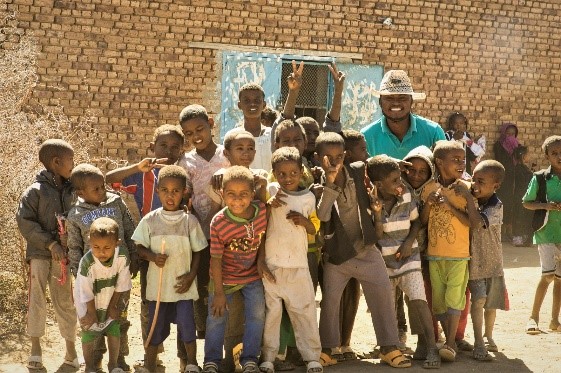
I was not the son of prominent families or intellectuals, but rather a son of the country, who was raised to value knowledge by a father who loved learning and a mother, who didn’t have a chance to access formal education. However, she learned directly from life and understood the importance of knowledge in people’s lives. When I received the news of my enrollment at the University of Khartoum, joy spread throughout the village, and my family members’ hearts filled with pride. While celebrating, my mother asked worriedly, “son, where will you stay? We have no family or relatives in Khartoum!!”

My departure date approached, yet we had no clear answer to that question. Then my elder brother came to reassure me, saying, “You’ve been enrolled at the most prestigious university in Sudan, and they also have on-campus housing.” At that moment, I tasted the joy of success and the fruit of my hard work for the first time.
During my stay at the dorms of the University of Khartoum, I started to realize a new world. I made friends from different parts of Sudan, each has his own culture and traditions, and I learned each day how to take responsibility and rely on myself. For me, university was a school of life that shaped my personality and my visions.
I graduated with high grades, which opened doors to me for academic research. I became a Teaching Assistant at my college and a Research Assistant at the Mycetoma Research Center. Early in my career, I began to realize that true researchers must be connected to their community’s struggles and work to alleviate them. A few days after my promotion to Lecturer at the University of Khartoum, war erupted. Its flames burned my dreams and the aspirations of my generation. I waited one hundred days at home, hoping the war would end, but I soon realized that once this fire ignited, it will not go out easily.
I had two choices: either continue my path despite the hardships, or to surrender to a slow death in an isolated corner, away from the world’s view. I reached out to my supervisors and friends, searching for a way out of the war zones, until I finally received a call that would save me.
I left Khartoum towards the White Nile State, where I worked with my colleagues to assist those fled the war in emergency shelters. We worked tirelessly to raise awareness about the dangers of neglected diseases and ways to prevent them. Then, I moved to Madani, Sennar, El-Faw, and Al-Gadarif. Along this journey, I heard the moans of patients whose voices were overshadowed by the sound of artillery, and I experienced the harsh conditions that pushed me to continue researching ways to relieve their suffering, alongside other researchers.
Life in those areas was tough; communication was difficult, sending an email or attending an online meeting was almost impossible, and even making a call sometimes felt like a luxury. The smiles of the children and the welcoming spirit of the community gave me strength, enough to fill me with hope.

Finally, I reached the Ethiopian Highlands for the first time in my life. I found the people of Ethiopia as kind as those in my homeland, and I was amazed by the beauty of nature and the mild climate, with temperatures ranging between 10 and 26 degrees. I noticed that Ethiopians held a special affection for Sudanese people, perhaps due to our shared cultural and geographical closeness.
I never imagined that I would one day live far from my homeland, but I was forced by the war. On a rainy evening in Addis Ababa, I asked myself, “Does a researcher have a homeland?” And I answered, “The homeland of a researcher is wherever he finds his scientific community.” Since that moment, I set out with greater determination to move forward, observing the differences around me, and I found Ethiopia a beautiful country worthy of reflection. I realized that research is a persistent and continuous endeavor that does not tolerate repeated excuses, just like prayer.
Thank you to Mesoud Bushara, we are very grateful to you for sharing such a moving story. Mesoud is a PhD Candidate on the GHRU Phase 2 on NTDs, and is conducting his research in Geospatial Mapping.

dear friend Mesoud
what you just told is a story that could bring the courage to others who faced a similar moments and struggles, personally I went through the same harsh time, at this time I want to thanks you for injecting more strength to my muscles to continue my journey regardless the bad memories of the war.