A report on the dissemination of 5S Foundation outcomes held between July – September 2025
The 5S Foundation Sudan team have been continuing to attend a variety of events to disseminate the research findings which emerged from the programme. This has included hosting a workshop, revisiting grass roots and IDP Camps, and public engagement at Mosques.
Workshop on findings
On Thursday, July 17, 2025, a workshop was held at the Red Sea University aimed at disseminating the findings of the 5S research project. The workshop was attended by forty five participants from grassroots community and IDPs camps and presentations were made by both co. PI of the project Dr. Ganawa and project coordinator of the 5S project for the University of Khartoum on the findings of the project.
Brochures and posters containing the outcomes of the research project were distributed to the participants and rich discussions were made by the participants which reflects a deep underrating of the 5S research findings related to the scabies. Towards the end of the workshop, scabies committees were formed and three members from each grassroots community and IDPs camps were chosen to be part of the committee for each site and other two members will be chosen from the IDPS camps from those who did not attend the meeting.

Photos from the dissemination workshop of the 5S research findings on 17th July 2025, Port Sudan city


Revisiting the grassroots groups and IDPs Camps
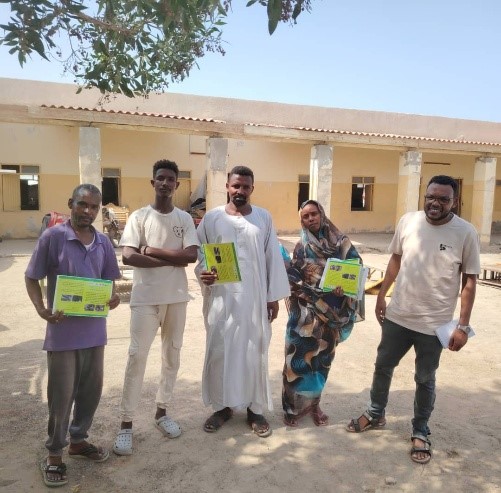
Based on the recommendations of the workshop held on July 17, 2025 local associations aiming at disseminating the findings of the 5S research project on scabies were established. Members from the 5S team-Sudan together with some members from established committees visited the grassroots community and IDPs camps and distributed the brochures and posters containing the scientific materials of the 5S research supported by the distribution of hygiene materials represented by various types of soaps for washing and showers as shown in the photos below:

Photos from Revisiting the IDPs Camps and Grassroots community, Port Sudan city


Meeting with the Public Religious Affairs
A joint meeting was held on Monday, September 15, 2025, bringing together the 5S Project Coordinator for Khartoum University, Dr. Ahmed Elfaig; the Dean of the Faculty of Arts and Humanities at the Red Sea University, Dr. Yasser Abdel Mahmoud; Shihab El-Din Suleiman from the FGES and the Director of the Public Religious Affairs, Sheikh Mohamed Onur.
Dr. Ahmed Elfaig provided a detailed explanation of the project’s objectives and work in Sudan. He stressed that the project is funded by the 5S foundation and it is a partnership between the Universities of Brighton and Sussex in the United Kingdom, and the Faculty of Geography and Environmental Sciences at the University of Khartoum, Sudan. Through the research conducted, the project reached a set of research findings by Sudanese researchers within Sudan. After completing the research, the research findings were disseminated to a wide range of audiences and shared with the largest number of beneficiaries and stakeholders, including grassroots communities and the IDPs. After a detailed explanation and lengthy discussion between the 5S project coordinator for the University of Khartoum and the Public directorate of Religious Affairs, it was agreed to disseminate the findings of the research through the Friday Sermon by 15 Imams of mosques in Port Sudan to provide a unified sermon for Friday prayers on September 19, 2025 addressing the worshippers on the scientific findings of the 5S research findings on scabies. Check; the link below.

Photos from some selected mosques on Friday Sermon, Port Sudan


Points from the Friday Sermon as a dissemination mechanism for the 5S Research findings
Friday Sermon: Scabies and its Health; Social and Religious Dimensions
Today we are talking about scabies, a skin disease caused by a small mite that affects all people, regardless of age or social status. It is usually transmitted through a direct contact or sharing contaminated clothing and bedding; and the infection is more prevalent in the situations of poor hygiene and crowding.
The cleanliness is not just a health measure; it is a part of faith. A faithful person takes care of himself and those around him, and knows that maintaining a good hygiene protects him and others from diseases, including scabies and other transmittable skin diseases.
The scabies has multiple effects:
- Health-wise:
It causes severe itching and skin irritation, and may lead to secondary infections if left untreated. Neglecting the treatment can also lead to more serious complications such as bacterial infections, and the affected person sufferers a sleep and daily concentration.
- Economically: It affects a person’s ability to work and produce, especially if it spreads among the workers and students. It also results in financial losses for families and the society due to some people losing their jobs or their productivity decline, which burdens the economic resources.
- Socially: Unfortunately, the patient may be isolated, and suffers social stigma which may affect the patient’s psychological state and feelings of shame or embarrassment in front of the society matter which weakens the social interaction and limits the individual’s participation in the daily life activities.
Towards the end of the Friday sermon, the Imams of the mosques have made some recommendations based on the outcomes of the 5S research findings:
- Every individual should take care of his hygiene, wash his clothes, sheets and bedding regularly with soap and water
- Avoid unnecessary direct contact with the infected people,
- Seek a prompt medical treatment.
- Scabies is not a shame; rather, it is a disease that can affect anyone, and we, as a community, must be supportive and compassionate toward those who are sick.
- We must use the results of this research on scabies to raise the awareness among the people in particularly the children, youth, women, vulnerable groups and adults about scabies and guiding the patients to treatment.