4th National Research Symposium on Neglected Tropical Diseases, Dire Dawa, Ethiopia
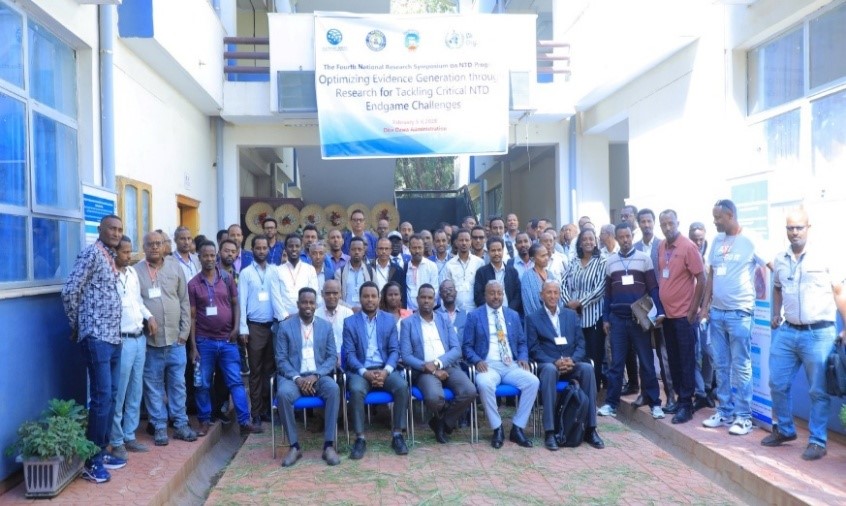
The Ethiopian Ministry of Health organized the 4th National NTD Research Symposium in conjunction with World NTD Day, taking place from February 5 to 7, 2025, in Dire Dawa, Ethiopia.
Many members from the 5S Foundation and the GHRU Phase 2 participated in this important event. The symposium theme was “Optimizing Evidence Generation Through Research for Tackling Critical NTD Endgame Challenges” and was jointly organized by the Ministry of Health, the Dire Dawa Health Bureau, and Dire Dawa University. It aimed to provide significant policy inputs and foster collaboration among various stakeholders. Attendees include researchers, policymakers, representatives from international organizations, leadership from the Dire Dawa Health Bureau, and senior management from Dire Dawa University.

From the GHRU Phase 2, Dr. Belete presented findings from the EndPoint project on “Ethiopian Medicinal Plants for Lymphoedema Wound Management.” His presentation attracted interest from many participants, including delegates from the Ministry of Health, WHO, and various NGOs. Visitors have expressed their appreciation for local efforts to develop treatments that are often overlooked, highlighting the importance of such initiatives in addressing NTDs.

On the 5th of February, Dr. Asrat Mengiste, Technical Advisor for the EnDPoINT 2 Project at CDT-Africa chaired an Oral Abstract Session on Skin NTDs and Psychosocial Impacts. He also attended a Calls to action workshop conducted on the 7th of Feb during the World NTD Day celebration where Prof. Getnet Tadele made a speech on “Amplifying Political Will and Action in the Fight Against Neglected Tropical Diseases” on behalf of all the NTD Champions.

The Symposium also featuring various plenary sessions, roundtable discussions, and oral and poster presentations organized under different sub-themes. One of the keynote speakers, Prof. Getnet Tadele, country lead and Principal Investigator of the 5S Foundation Ethiopia, delivered an address on “Social and Behavioral Sciences for NTD Control and Elimination in Ethiopia.”
Prof. Getnet began his keynote address by acknowledging the Ministry of Health, the symposium organizers, and others for recognizing the importance of social sciences in NTD research programs.
In his speech, Prof. Getnet pointed out that political and socio-economic issues such as poverty, education levels, gender, ethnicity, social class, and access to health services, water, hygiene, and sanitation are significant factors contributing to NTDs. He emphasized that inequality is the primary pathogenic force behind these diseases.

Additionally, he discussed how current challenges in our country—such as migration, displacement, conflicts, and inflation—exacerbate NTD issues and underscore the importance of social and behavioral sciences in addressing these challenges.
Prof. Getnet also shared insights from the 5S Foundation research project, highlighting how perspectives from social sciences help contextualize diseases and clarify the complexities surrounding them. Social science research is crucial for understanding people’s perspectives and recognizing cultural sensitivities.
He raised important sociological questions related to NTDs (such as podoconiosis), including: Why don’t people wear shoes? Why don’t they take medications? He emphasized that understanding the reasons behind these perceptions is vital. A supportive social environment is just as important as medical or biological treatments for preventing NTDs; therefore, it is essential to consider power dynamics, dignity, and social relationships.
He outlined the following critical points that must be done:
• Political Commitment and Sustainable Financing
• Community Engagement and Local Context
• Impactful Research: Scientific Research and Evidence-Based Policies
• Strengthening Primary Healthcare and Universal Coverage
• Ensuring Cross-Sectoral Collaboration
• Addressing Misinformation, Trust, and Public Perception
• Promoting Gender and Social Inclusion in NTD Programs
• Strengthening Livelihoods
• Integrating Traditional and Modern Medicine
In his concluding remarks, Prof. Getnet issued a call to action, emphasizing that efforts to prevent NTDs must be multi-dimensional. He highlighted the importance of dignity, empowerment, and systemic change within NTD programs, advocating for social research, community-led initiatives, and inclusive healthcare systems. Strong collaboration among researchers is vital, and public health success depends on human behaviour, community engagement, and structural changes. We must move beyond short-term solutions to achieve sustainable, community-driven change. Understanding how people think, behave, and interact socially is just as crucial as medical interventions
Following Prof. Getnet’s keynote speech, three panellists reflected on the significance of Social and Behavioural Sciences for NTD Control and Elimination in Ethiopia. The audience then posed questions and comments to the panellists and keynote speakers, who responded accordingly. This session underscored the critical role of social sciences in preventing NTDs and highlighted how key stakeholders recognize their importance in combating these diseases.

Two PhD fellows from the 5S Foundation, Addisu Tsegaye (PhD) and Bikila Ayele, presented their research findings at the research symposium. Addisu (PhD) presented a paper titled “The Paradox of Normalization and Stigma: Understanding Scabies in the Precarious Living Conditions of Nguenyyiel Refugee Camp, Ethiopia.” He began his presentation by providing background information, outlining the problem statement, objectives, and methods of the study.
Addisu’s research findings reveal a complex interplay between stigma and the normalization of scabies among refugees in the Nguenyyiel camp. While adults tend to view scabies, known locally as Gogne or Gutyiel, as an inevitable aspect of refugee life—reflecting a resignation to their circumstances—young people experience significant shame and stigma associated with the condition, primarily due to its links to poor personal hygiene. This generational divide creates a situation where youths feel pressured to self-stigmatize or conceal their concerns about scabies symptoms, as they are often blamed for their heightened awareness of the issue.
Addisu mentioned that the refugees’ transition to camp life significantly diminishes their autonomy, limiting access to essential resources such as water, sanitation, and healthcare services. This systemic vulnerability is exacerbated by the regulated humanitarian services provided in permanent camps, which perpetuate structural violence. Consequently, while adults dismiss scabies as a normal part of their environment—reflecting what can be termed “social suffering”—youths grapple with the bodily impacts of the condition and feel compelled to normalize it as well. Addisu (PhD) also highlighted that the stigmatization of scabies as a hygiene issue obscures deeper systemic failures, ultimately highlighting how social inequalities manifest as embodied stigma within this vulnerable population.

Addisu (PhD) concluded his presentation by stating that stigma is not merely a static social marker but a dynamic process shaped by the intersection of displacement-induced precarity, structural violence, and societal expectations. Therefore, it is crucial to address the root causes of refugees’ vulnerability to scabies in camps by alleviating their plight in protracted situations. Interventions for scabies should be tailored to the specific circumstances of refugees.
Bikila Ayele, also of the 5S Foundation presented a research paper during the symposium titled “Stigma and Illness Management Among Podoconiosis Patients in Rural Ethiopia: An Intersectional Hermeneutic Study.” Similarly, Bikila began his presentation by providing background information and explaining the problem statement, objectives, and methods of the study. His findings highlighted three stages of patients’ journeys: Early Symptom Overlook and Pre-Stigma; Disfigurement, Disease Rebranding, and Active Resistance; and Despair and Acceptance. He emphasized that these stages illustrate the dynamics and evolving nature of stigma and illness management.

Bikila’s findings further reveal significant disparities in experiences of stigma and management strategies, shaped by intersecting factors such as gender norms, age, socio-economic status, social capital, and limited access to healthcare services in rural communities. In conclusion, Bikila stressed the urgent need for targeted interventions to address the root causes of stigma and barriers to care. Community education to challenge misconceptions, improve healthcare access, and integrate culturally sensitive support mechanisms for marginalized individuals could prove effective.
Following the presentations, various questions and comments were directed to the presenters, who addressed them accordingly.

This report was complied by Rachel Jackson, using original material from 5S Foundation Ethiopia Facebook and reports from Samrawit Ketema, Belete Legesse, Getnet Tadele and Asrat Mengiste.