From 24th – 26th March, the World Health Organization hosted its Second WHO Global Meeting on skin related neglected tropical diseases (NTDs) in Geneva and online, under the theme of “Integration to achieve 2030 targets”.
We were very proud to have presenters and poster displays from researchers from across the GHRU and 5S Foundation in attendance.
The purpose of the meeting was to build on the implementation of the WHO NTD Road Map 2021–2030 and brought together experts across 13 areas related to Skin NTDs, with objectives to share the progress and challenges or implementing integrated activities on NTDs at country level. It heard updates on the progress made by working groups/areas of skin NTDs and was a great opportunity to strengthen networks between a wide range of global stakeholders.
The posters featured at the global meeting were:

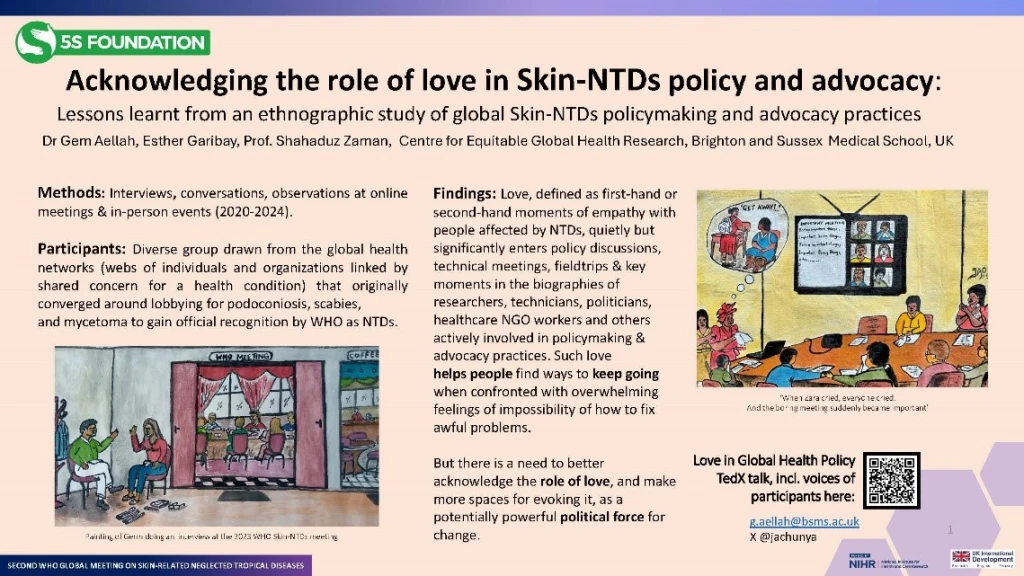
Acknowledging the role of love in Skin-NTDs policy and advocacy: Lessons learnt from an ethnographic study of global Skin-NTDs policymaking and advocacy practices; by Gem Aellah, 5S PDRF

The role of NGOs in mainstreaming services for podoconiosis into healthcare facilities: The case of two NGOs in Ethiopia By Kibur Engdawork, 5S PDRF

What we want the world to know: the Skin-NTDs research questions that matter most to people affected by leprosy in India; Dr Gem Aellah 5S PDRF

“Developing principles of inclusion for operational research: A partnership with persons affected by Neglected Tropical Diseases: How can we move from tokenistic inclusion of persons affected in research, to a culture where persons affected by NTDs are valued contributors to scientific advancements?”
In this poster, you will see a QR code asking for contributory feedback on these early-stage principles, especially from people with lived experience or researchers who have run research projects that include them in decision making, or who have thoughts about it. Please do share this widely with anyone deemed appropriate!
By Gem Aellah, 5S PDRF

“Stigma and Illness Management among Podoconiosis Patients in Rural Ethiopia: An Intersectional-Hermeneutic Study” by Bikila Ayele, 5S PhD

“From co-existence to collaboration: The need to move towards an inclusive pluricultural approach to scabies control in Debre Elias, Ethiopia”, by Dereje Wonde
Presentations
Professor Gail Davey, Principal Investigator of the 5S Foundation summarised the update from the Operational Research Working Group, of which she is chair. This was on the topic of “Guidance for Inclusion of People with Lived Experience’. More of this can be explored in Poster 3.


Dr Corinna Thellmann, ECR from the 5S Foundation, presented her research on “Women’s Access to and Participation in a Disease Management Intervention for Podoconiosis in Rwanda:
Challenges and Recommendations”.
She outlined the focus of the study, highlighting difficulties accessing appropriate treatment and the inability of healthcare workers to diagnose Podo. She concluded with recommendations for policy and practice regarding access to diagnosis and treatment, continuous participation in disease management intervention, and the reconsideration of the role of family support in Podoconiosis care.


Conclusion:
Bringing together global health leaders, researchers, and affected community representatives, the meeting served as a critical platform for sharing progress, challenges, and innovative strategies. As momentum builds toward the WHO’s 2030 NTD roadmap targets, the outcomes of this gathering reaffirm the global commitment to equity in health and the importance of sustained action to alleviate the burden of skin-related NTDs worldwide.
WHO-AFRO/Podoconiosis Side Meeting
Tuesday 25th March 2025, 17:00 CET
A side meeting was linked to the Second WHO Skin NTD Meeting in Geneva, to enable discussion of a potential Regional Platform for Podoconiosis Elimination. Prof Gail Davey (BSMS) chaired the hybrid meeting, which included representatives of WHO HQ, WHO-AFRO, the Ministries of Health of Ethiopia & Rwanda, implementers from Ethiopia & Rwanda, funder organisations (IZUMI Foundation, CIFF and Footwork) and academic colleagues from Cameroon, Ethiopia and Rwanda.

After exchanging information on the burden of disease, national approaches to elimination programmes and the rationale for an AFRO Regional Platform, participants agreed a set of next steps. These will include setting up communication across podoconiosis experts in the region, support for countries needing to include podoconiosis in their national NTD masterplans and identification of champions within the health ministries of endemic countries.