Introduction
Community Engagement and Involvement (CEI) approaches seek to deepen understandings of community perspectives on research agendas, and to shift research practices in the direction of collaboration and co-production. While there are a significant – and growing – set of methods, tools, and training opportunities that guide researchers in how to ‘do’ CEI, there is much less in the public domain that documents the lived experience of CEI practitioners. It is also often the case that those individuals tasked with this role are often more ‘junior’ or early career members of research teams. What can get lost when a health research project with embedded CEI is translated into peer-reviewed academic journal articles are the moral ambiguities and the emotional impacts of this more intimate way of working.
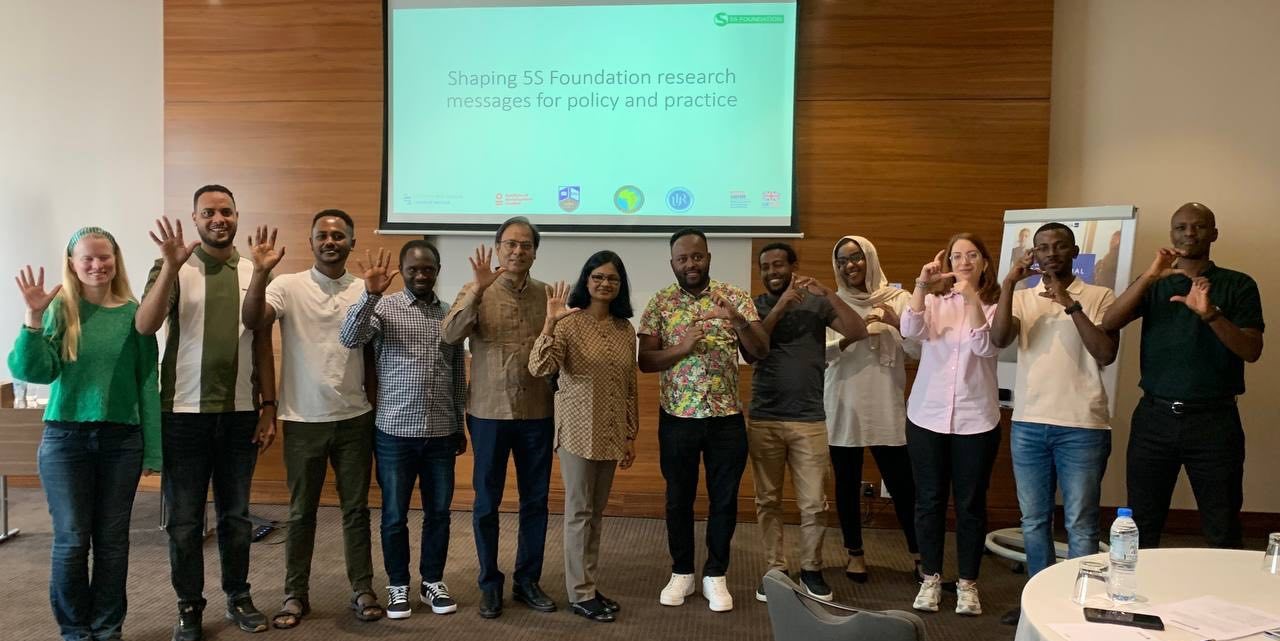
Between October 2022 and May 2024, the Institute for Development Studies (IDS) hosted four roundtable discussions with groups of early career researchers (ECRs) affiliated with the Social Sciences for Severe Stigmatising Skin Conditions (5S) Foundation. Our aim was to create a space for critical reflection and sharing learning amongst a group that had been working across a range of challenging and – at times – isolated contexts. In these discussions we talked about what happens as researchers when you are put in the position of identifying problems that are not easy to solve? We also spoke openly about the challenges when faced with the real-world impacts of neglect and stigma, and what responsibilities do researchers have to those who share their own stories of trauma and suffering? The first three roundtables (one in October 2022, two in May 2023) were transcribed and shared back with all participating ECRs in preparation for a final all-group discussion held at the end-of-project workshop in Addis Ababa, May 2024.
Here we capture some of what emerged in these discussions, with the hopes that these insights provide useful insights and a sense of ‘common cause’ for those tasked with doing CEI work within the NIHR global health research portfolio. A shared thread across all four roundtable conversations was that the researchers felt that training materials and advice on CEI make it ‘sound so much simpler’ when in fact how you build rapport or wrestle with the day-to-day ethical dilemmas of engaged research can be very difficult to navigate in practice, or what Corinna called ‘the humanness of it’.
Questioning the CEI role
For the ECRs, each had a distinct starting point to becoming an “intermediary, a broker” and the person “carrying the stories, perspectives and experiences of people who cannot move from where they are” (Hala). For some, even if doing research in their countries of origin, they had not spent time in the regions where 5S activities were being carried out, far from the capital city. For some, having trained in medicine or public health, it was a new experience to do qualitative research in places of high need and not be able to deliver clinical care. For others, being foreigners entailed certain privileges of access to local officials but came with the challenges of relying on translators and navigating distinct barriers of trust. People don’t know which hat the researcher is wearing – are you working for a charity? Are you a doctor? Have you come to give out supplies, or just asking questions?
In Hala’s case, having been educated and worked in Khartoum, going to carry out work in South Sudan in refugee camps was not without risks. When first scoping out the camps it transpired that there was a general strike among residents against the perceived corruption of the committee of refugees. “They say that these people come to us, they take knowledge, they take our data, and they give us nothing in return,” explained Hala, so she withdrew from initiating direct research and invested time instead rebuilding a relationship with local community leaders to establish her independence.
Similarly, Badraldeen recalled how,
“when I came to the community, it was quite challenging, even from the first time, always the patient, they expected medicine, and they’re just keen on medicine, and they ask very obvious questions, what did you do after doing this research? What are we going to benefit from this research?”
In not having an immediate answer – or an immediate clinical response to the health challenges raised – the ECRs invariably tried to find other means to address community needs. For Hala this looked like developing a community theatre programme to educate young people about scabies and stigma at the behest of local parents who said they needed to raise awareness at the schools. For Jean Paul in Rwanda, it meant building strong social ties with local communities and friendships that he continues to maintain. For Corinna it meant responding by ensuring that participants in research were reimbursed, so that these funds could go towards immediate needs:
“I made sure actually that they received money whenever they took part in any type of data collection, because I just felt I should…because I’m taking their time, I’m in their space, and there’s a need, so I will still pay for every single time they take part in any type of interview or observation with me, but that’s just like a drop.”
What was common across the ECRs was the experience of navigating these moral dilemmas and managing community expectations in a day-to-day way – without clear guidelines or an in-person team to fall back on. When local research participants asked the hard questions – How will your research benefit me? Why are you asking these questions? Why can’t you just give our community what we need? – it was up to the ECR CEI practitioners to work out necessarily imperfect responses while still maintaining credibility and trust. As reflected by Hala,
“Being part of the 5S taught me something about the power dynamic, and how we always ask questions, and how we always seem to be looking at certain answers…or we try to dig and look for a certain answer which is not 100% right? Because there is no right and wrong answer. So, being part of that community and going there almost every day for a period of time told me that these people have stories.”
Learning by Doing
To go and live in places deeply impacted by stigmatised skin conditions, and to sit and listen to people’s stories of living and suffering, as a result of contracting these diseases, necessarily provokes a shift away from a purely clinical understanding. Amongst those who analyse health inequities, the concept of “social determinants of health” is a familiar one – but it can be a very different experience to look at health inequities as flattened statistics versus to witness them play out in daily life. Addisu, Jean Paul and Badraldeen all agreed that the experience of working for 5S had helped to develop their understanding of the social dimensions of health. The work demanded that they consider how structures, institutions, culture, and economics influence and interact with health outcomes and to think of the drivers of ill health or good health beyond access to medicine.
As Addisu explains, “We should be looking at other factors – the availability of clean water, the availability of health care, culture, economy, even at individual level, at community level, policies, the attention of federal government – this all contributes to health and health problems of the community. Being part of this project has helped me understanding what I theoretically knew, and now I have seen these things in the refugee camp.”
Similarly, in hearing directly from people living with podoconiosis*, mycetoma and scabies, it changed their own views on these NTDs themselves, having previously not given them much attention or concern. For Jean Paul, who had previously worked in public health, transitioning to a social research position meant that, he was hearing “very touching stories from patients, about their suffering” and instead of “telling” patients what he thought they needed to hear, this way of engaging meant that he had to listen and try to better understand their knowledge and perspectives on health.
“Listening” sounds like a simple act, but in fact it involved substantial risks on the part of the research team travelling to get to the places where such attentive listening was needed. For example, Addisu, based in Ethiopia, had to travel across zones of conflict to get to the refugee camps at which his study was based. As a father, and husband, he had to weigh up carefully the risks involved simply to do his job. “Travelling by bus to the research area was impossible – there was also the chance that roads might close, that I might not get back to my family, so all of this made me think twice, three times before I went to Gambela.” He persisted, and when it was possible, went to spend a period in the refugee camps far from his urban home around Addis Ababa, the capital city of Ethiopia. The experience of facing research adversity was described by Addisu, Badraldeen and Jean Paul as “empowering” because in spite feeling they didn’t have all the answers to the complex situations they confronted once situated in these places, they navigated their way through the complexity and towards a much more profound understanding of what ‘neglect’ in NTDs means in practice.
Gender and CEI
For one of the roundtable discussions, we limited the discussion to women-only ECRs. The rationale for this was to hear perspectives on any gender-specific dimensions of doing CEI in practice. Corinna Thellman, for her part, had a local female Research Assistant working with her. One day, when Corinna was unable to do an interview scheduled with the director of the district, she sent her Research Assistant (RA). However, the director, was not treating her RA very well.
“He would look her up and down, and he was like, ‘where is your boss meeting me?’ When she wanted to start the interview, even though he had all the records he kept being like “I need to see the ethics certificate. I will not do this interview.” He kept making it hard for her, and he kept doing power moves about where he wants to sit. He really asserted his dominance and made her feel bad.”
In Tseganesh’s case, who carried out her work predominantly in rural areas, she struggled at times to get women to speak because they were too afraid. As a solution, she kept sessions short with women who struggled to commit to a whole hour and just kept coming back. In one case, it took three times to gain the trust of one female participant to gain an invite for a chat in her home. Later, she asked this woman “why were you afraid to talk to me about your story when we first met, and she said, “I was not sure whether you are listening to my story and would not let the others know.”
Changed Agents
In global health, the concept of a “change agent” or “champion” has long been used to describe those individuals who are in the position to leverage influence and drive health systems change at community, regional or even national level. The 5S project did not use the language of “change agent” to describe the effects of training up a cohort of Sudanese, Rwandan and Ethiopian social science researchers, but they have become change agents, nonetheless. What Badraldeen, Addisu and Jean Paul described in our conversation was a process through which their direct witnessing of neglect became a commitment to do something on behalf of those neglected. They spoke of the “heart breaking” effect of observing people’s suffering. Each had very particular stories that were now lodged in their memory. For Badraldeen, it was a man who lost his family after a double leg amputation, necessitated by the spread of mycetoma in his body. This man “was so happy to just have someone to talk to” having been abandoned by his family and without visitors for over a month. “He was crying, so depressed, I ask daily for Allah to come and take my life,” Badraldeen told us, “I couldn’t stop crying as well. He used to be a good and healthy man.” Whenever Badraldeen goes back to the community now as part of his ongoing research, he checks in on this man, to see how he is doing, and compensates him beyond his contribution to the project with money “from my own pocket”.
For Jean Paul, the story that lodged with him was that of a pregnant woman with podo who was divorced and sent back to her mother, who also has podo. This mother and daughter live in chronic poverty.
“Now that I am transcribing recordings,” he shared, “it is all coming back…for example there was this woman who is now 45 or so, she used to be married but now she is divorced. She was pregnant and had podoconiosis, with very swollen legs. She was in incredible pain, and meanwhile her husband had decided to send her back home (to her family of origin) and divorce her. Her mother had podoconiosis too. It was an incredibly touching story.”
Similarly, Addisu related that, “when I am transcribing interviews I can remember exactly where I sat, that moment. There was this woman, who showed me a picture of what she looked like when she was young, when her life was doing well. Before the interview started, she was describing how much her life had changed.”
Reflecting on the picture, Addisu explained that at this earlier point in her life “she was very beautiful and well dressed” but the effects of disease and the consequences to her family life have changed her life circumstances dramatically.
These incredibly touching and difficult-to-hear stories are not just fodder for qualitative data analysis. They leave their marks on the listener – and in this case, three young men for whom such stories have created forks in their professional paths. As Addisu tells it,
“from my study site, what they are lacking is the necessary consideration of neglect, but they are in serious neglect, marginalization, where the policies have already contributed to a lack of prolonged detachment from either the national system, and their country of origin. So, I think, as a social scientist, we need to look at how these structural forces have contributed to their everyday suffering. Like, the medicine might not change the condition in the camp setting.“
Strengthened Commitment
To return to the questions where we began: what happens to researchers when you are identifying problems that are not easy to solve? What responsibilities do researchers have to those whose stories are shared? What emerged most clearly from these conversations are a commitment that this whole cohort of ECRs share: that social science approaches matter, that social science can play a role in their country’s efforts to tackle NTDs, and that they must continue to work together to build a deeper understanding of the complex effects of stigmatised skin conditions on people’s lives, as well as grappling with the complex (social, clinical, material, political) responses required to mitigate these harms. A common frustration for all is that people continue to think that NTDs are not a “big issue” and that “culture is a barrier” to progress on NTDs. This simplistic and dismissive view fails to see the bigger picture: that communities of diverse cultures have a role to play in addressing disease and improving health outcomes, but only if they are engaged in research processes in meaningful ways.
As Badraldeen put it, “I am so happy to be involved in a project that looks at the most neglected diseases because I could see how people were neglected within their communities, by their own families, by the medical community, by the government.”
This reality necessitates a commitment to reverse neglect in all these distinct spaces. Addisu explained that “We don’t have to stop here, just with getting our PhDs and then resume our normal activities. 5S has given us an opportunity to interact with each other. We have been listening to stories from Rwanda, from Sudan, we have common agendas. This should not stop here or somewhere; we must build on what we have done and make use of the knowledge that we have gained to produce something relevant to our societies and our discipline.”
To do their work well required emotional engagement with the subjects of their research, and a willingness to bear witness to the tragedies suffered by individuals and families, because of contracting these skin conditions. Perhaps, most significantly, the experience has given these CEI practitioners a shared purpose and a desire to continue. Jean Paul put it best: “Working together has become our battle cry, but you know, learning is a long life. We expect much more to come.”
*Podoconiosis is a progressive, debilitating form of leg swelling caused by many years of barefoot contact with irritant soil in highland tropical areas. Podoconiosis affects some of the most disadvantaged people in 27 countries across three continents.